The Human Side of Leadership
AI Is Changing How We Work. Are We Developing the People Who Lead It?
We're investing in AI, technology, systems, and finding talented people. But are we investing enough in developing the people responsible for making it all work?
Before You Plan Next Year
Does Any of This Sound Familiar?
Before you build next year's leadership development calendar, take a closer look at what's happening on your team today.
Select the one that sounds most familiar.
Tracy's Perspective
Technology helps us work smarter. People still lead the work.
Trust me, I love AI. I use it in my own business and see tremendous opportunities in what it can help us accomplish.
But the more technology changes how we work, the more important it becomes to intentionally develop the people leading the work.
Technology can help us organize information, identify possibilities, and work more efficiently. But building trust, navigating difficult conversations, understanding our impact on others, making thoughtful decisions, and creating accountability still require human judgment and action.
AI can absolutely support development. It can help a leader prepare for a hard conversation, reflect on feedback, or practice a new approach. What it can't do is have the conversation for them, rebuild trust on their behalf, or own the decision once it's made.
That's where real development lives, not in the insight alone, but in what we do with it. We learn something about ourselves, we try it on Monday morning, we notice what happens, and we adjust. Over time, that practice becomes how we lead.
So the question isn't whether to invest in technology or in people. It's whether we're being as intentional about developing our leaders as we are about everything else.
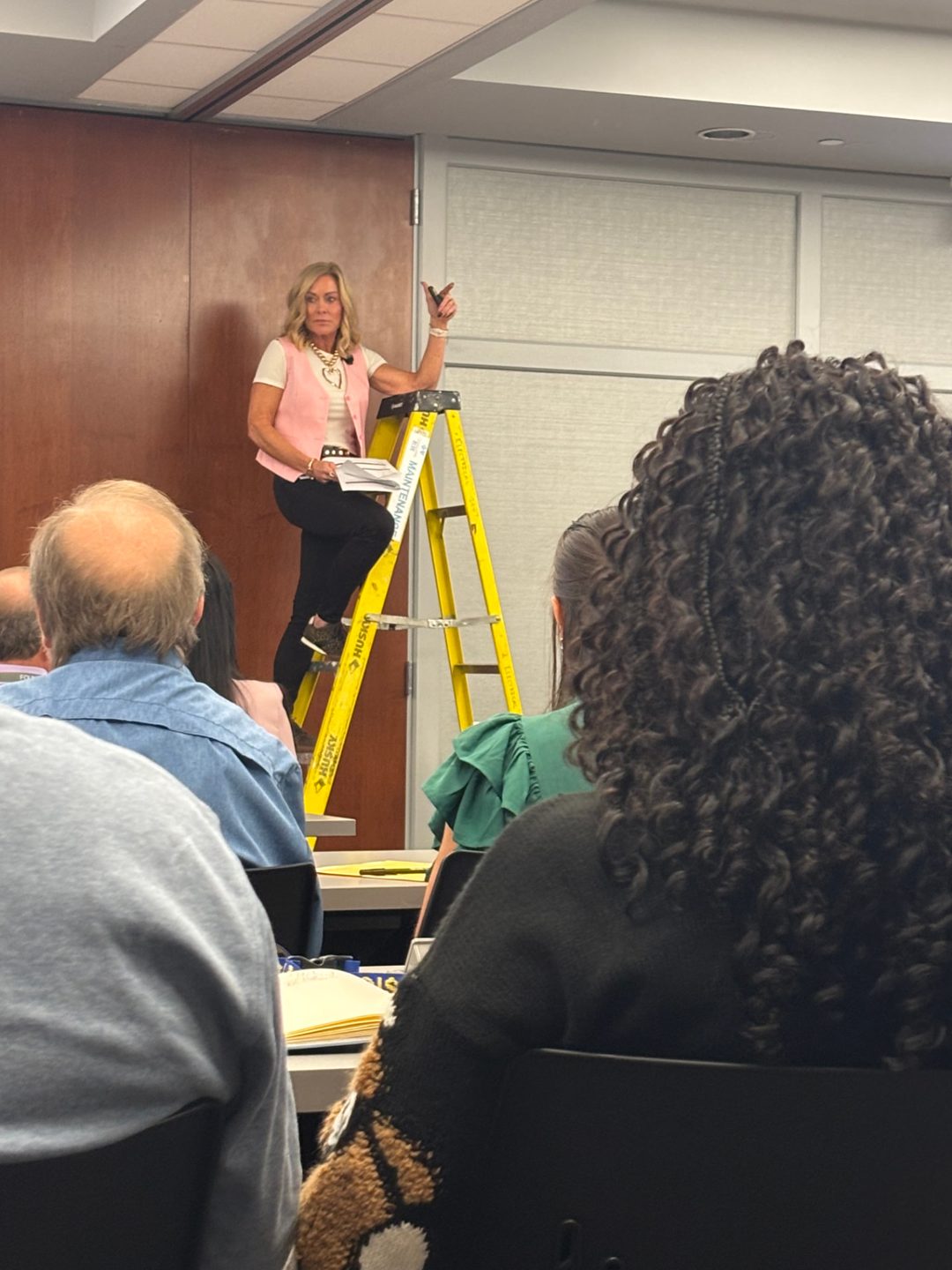
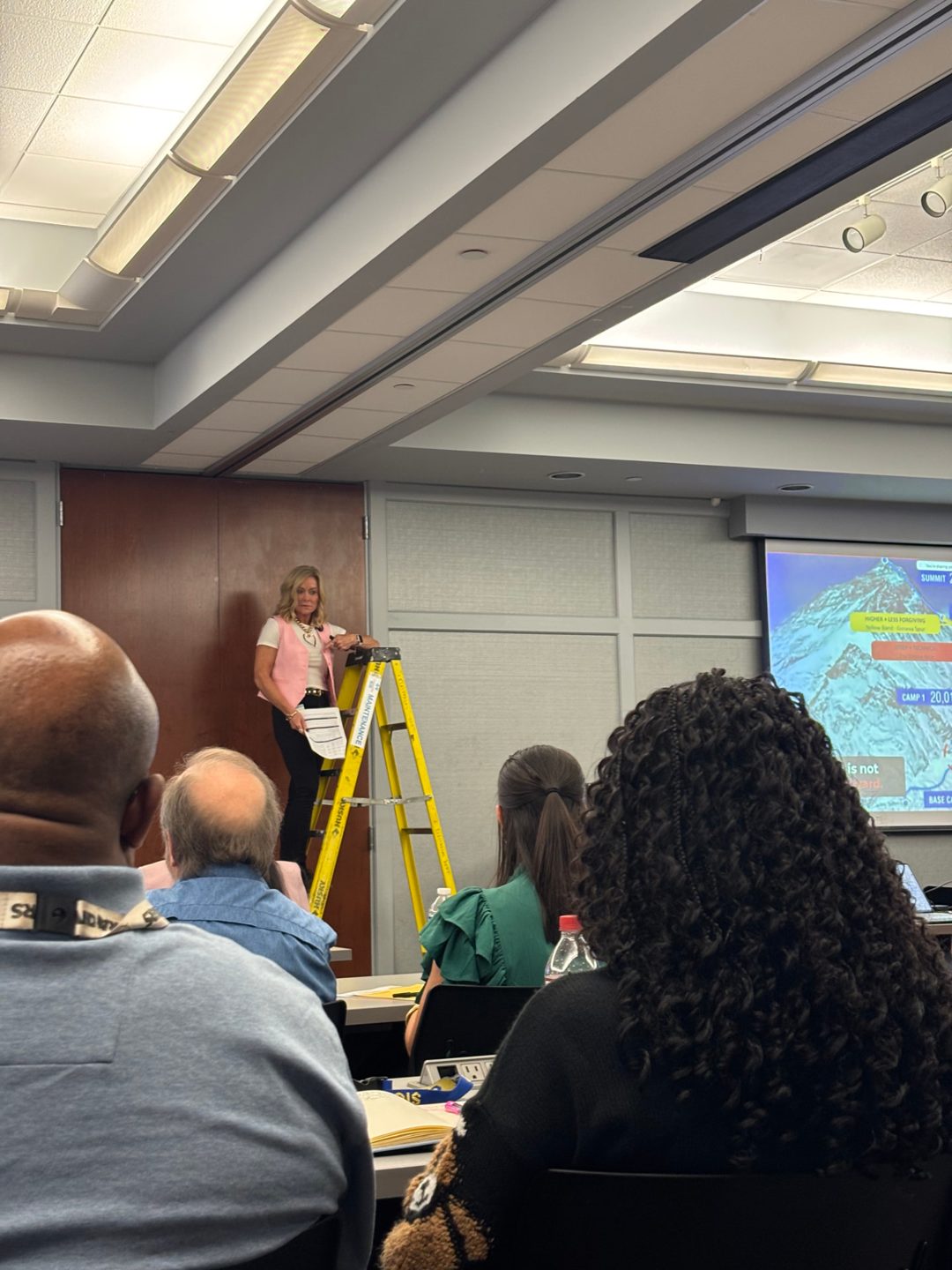
A Real Leadership Experience · Louisiana Blue
How You Lead Is Experienced Before It's Explained.
So why am I standing on a ladder?
- Audience
- ~100 project managers & delivery leaders
- Format
- 90-minute session
- Where
- Louisiana Blue, Baton Rouge
The challenge: What a leader intends is not automatically what others experience. And what others experience shapes what happens next.
The experience: Alison Levine's Everest story opened a conversation about challenge, preparation, and setbacks. A real yellow ladder on stage made accountability something people could see. Then we talked about the situations they face every week.
The application: The Accountability Ladder, my CLIMB Reset Method, and four leadership dimensions gave people practical language to use the next day.
The takeaway
Each participant wrote their own "I WILL" commitment.
Behind the Experience
The Accountability Ladder
Helps leaders recognize where they and their teams may be getting stuck: blame, avoidance, ownership, or taking action.
The CLIMB Reset Method
For when the same issues keep coming back. It starts with a pause, then five actions: Call It, Locate It, Investigate It, Move It, Build It.
Four Leadership Dimensions
Lead Yourself, Lead Others, Lead the Work, and Lead Forward: a way to organize where leadership shows up. Explore them below.
A Leadership Moment
Are people experiencing the leadership you intend to provide?
A project is slipping. You care about the team and want to protect the deadline, so you start joining every stand-up, asking for daily status updates, and quietly reworking a few deliverables yourself. You intend support. How might the team experience it?
The Leadership Decision Lab
Now It's Your Turn.
You don't have to stand on a ladder to recognize where accountability may be getting stuck. Let's see how you would handle a familiar leadership challenge.
About three minutes. No sign-up needed.
For Your Organization
What This Could Look Like for Your Team
Talk With Tracy About Your Team (opens in a new tab)Every engagement starts with the challenges your leaders and teams are actually facing. From there, I shape the format and tools around them.
Keynotes
A memorable message for a conference, kickoff, or leadership meeting.
Learn more → (opens in a new tab)Offsites
Time away to align, reset, and plan how the team will work together.
Learn more → (opens in a new tab)Workshops
Hands-on sessions on accountability, collaboration, trust, and more.
Learn more → (opens in a new tab)Development engagements
Ongoing leadership development built on assessments, coaching, and practice.
Learn more → (opens in a new tab)
Four Dimensions of Leadership
Leadership Development Starts With How We Lead.
Select a dimension to explore what it means, where leaders often get stuck, and one thing to try.
- What it means
- Knowing how you show up, your tendencies under pressure, what drives you, and how your behavior lands with the people around you.
- A common challenge
- Moving fast and making good decisions, while missing how the pace or tone of those decisions affects the team.
- Reflect
- When I'm under pressure, what do people around me experience?
- Try this
- Ask one trusted colleague: "What's one thing I do that helps you, and one thing that gets in your way?" Then just listen.
- What it means
- Building the relationships that make good work possible, trust, honest conversation, and helping people grow.
- A common challenge
- Important conversations get delayed or softened until frustration builds and trust erodes.
- Reflect
- Which conversation have I been postponing, and what is waiting costing us?
- Try this
- Schedule the conversation you've been avoiding. Open with curiosity: "Help me understand how you're seeing this."
- What it means
- Creating the clarity people need to deliver: who decides, who owns what, what 'done' looks like, and how we follow through.
- A common challenge
- Everyone leaves the meeting nodding, yet ownership is unclear and the work stalls.
- Reflect
- If I asked three people on my team who owns our top priority, would I hear the same answer?
- Try this
- End your next meeting by confirming, out loud, each commitment: who, what, and by when.
- What it means
- Developing the people and capabilities your organization will need tomorrow, not just meeting today's demands.
- A common challenge
- Today's urgency crowds out the development of tomorrow's leaders, until a key person leaves and the gap becomes obvious.
- Reflect
- Who on my team could step into a bigger role in two years, and what am I doing to prepare them?
- Try this
- Choose one emerging leader and give them a stretch responsibility, with support, this month.
A Short Reflection
Where Could Your Leadership Make the Biggest Difference?
You don't have to improve everything at once. Sometimes one focused change can make a meaningful difference.
Question 1 of 4
This is a reflection exercise, not a formal or validated assessment. Your answers stay in your browser and are not stored or shared.
After the Hire
We Invest in Hiring. What Happens Next?
Organizations invest considerable time and resources in finding talented people. But hiring someone is the beginning of development, not the end.
Multi-science assessments can offer a useful starting point. Used well, they can provide insight into:
- Behaviors
- Driving forces and motivations
- Competencies
- Acumen and decision-making perspectives
- Emotional intelligence, where relevant
Different tools measure different things, so each should be selected for a specific purpose. For example, TriMetrix HD looks at Behaviors, Driving Forces, Competencies, and Acumen, while TriMetrix EQ looks at Behaviors, Driving Forces, and Emotional Quotient. Working Genius, by contrast, describes how people contribute to work and is not a hiring tool on its own. An assessment doesn't guarantee performance, predict success with certainty, or replace structured interviews and other evidence. What it can do is open a better conversation.
"Assessment creates insight. Application creates change."
Insight becomes valuable when it informs coaching, clarifies development priorities, sparks honest team conversations, and supports more intentional talent decisions. The report is the start. The practice that follows is where growth happens.
Connected Insights
Different Tools. Connected Insights. Better Leadership Decisions.
No single assessment or framework explains everything about a person, a team, or an organization. The value comes from understanding the situation, using the right tools, and applying what we learn.
Different Challenges, Different Starting Points
The Right Development Starts With the Right Question.
Working Genius
For understanding how people contribute to work, where energy and frustration arise, and how teams collaborate.
Learn more → (opens in a new tab)Five Dysfunctions of a Team
For strengthening trust, productive conflict, commitment, accountability, and collective results, including Wiley's Five Behaviors of a Cohesive Team program.
Learn more → (opens in a new tab)Multi-Science Assessments
For exploring behaviors, motivations, competencies, and other relevant development insights.
Learn more → (opens in a new tab)Development by Design
For translating insight into intentional behavior change, leadership capability, and stronger performance.
Learn more → (opens in a new tab)Your Next Move
One Focus. One Conversation. One Next Move.
Complete the short leadership reflection to see your personalized action card.
Find My Leadership FocusAs You Look Ahead, What Will You Develop?
The tools will keep changing. The need for thoughtful, self-aware, accountable leaders won't. You don't need to fix everything this year. Choose one capability, in yourself, your team, or your organization, that could make a meaningful difference, and develop it on purpose.
See the pattern. Change the behavior. Strengthen the team.
Performance by Design. Not by chance.
You don't need to know which program you need. Tell Tracy what keeps happening.
Talk With Tracy (opens in a new tab)